Industrial AI
PID Is Dead. Long Live PID.
Industrial AI extends the control stack with current estimates, earlier predictions, and optimal setpoints while PID continues to control the process.
- Industrial AI
- Process Control
- Optimization
PID is dead. Long live PID.
That is not an argument against proportional-integral-derivative control. PID remains one of the most useful and durable tools in industrial engineering. It holds pressure, temperature, flow, level, composition, and countless other process variables near their setpoints every day.
The larger change is the stack around it.
Industrial operations now combine process engineering, instrumentation, distributed control systems, supervisory control and data acquisition systems, historians, first-principles calculations, data-driven models, prediction, optimization, software integration, large language models, agents, and automation harnesses.
Each layer has a job. The strongest industrial systems do not ask one layer to pretend it is all the others.
PID is still there. We set the setpoints optimally.
I lived the expansion of this stack
I started as a chemical engineer at Oregon State University. At 3M, I worked across process, product, and project engineering. Then someone needed a data historian.
That requirement moved me into information technology. I learned how operating data was collected, stored, connected, and delivered. I advanced through IT, then left a strong career to start an industrial artificial intelligence company in 1994.
I wrote my own genetic-algorithm and neural-network libraries. I combined evolutionary search with neural models. Then came decades of field implementation: virtual measurements, product-property predictions, process diagnosis, production optimization, calculated setpoints, control-system integration, automatic model-performance management, and applications that had to keep working, 24/7/365, after the development team went home.
Large language models, agents, and harnesses are now additional layers. They are important, but they do not repeal process dynamics, instrumentation, control theory, material balances, equipment limits, safety logic, or the need for reliable online execution.
The stack grew. The physical process did not stop being physical.
PID does its job exceptionally well
A PID controller compares a measured process variable with its setpoint. It calculates the control action needed to reduce the error. It repeats that work continuously.
That feedback loop is powerful because it is focused, fast, established, and close to the process.
PID does not need to understand the entire plant. It does not need to predict tomorrow. It does not need to decide the most profitable combination of production, quality, energy, raw materials, equipment limits, and downstream capacity.
Those are different jobs.
The setpoint defines the control objective
A setpoint tells the control function what value to hold the process to. Selecting that value requires more information than a PID loop contains.
The best setpoint can depend on:
- current feed composition
- equipment condition
- interacting process constraints
- product-quality limits
- energy and material costs
- downstream capacity
- production objectives
- product properties response to materials and process conditions
- delayed laboratory or analyzer results
- estimated values that cannot be measured continuously
- predictions of what the process will produce next
This is where our industrial artificial intelligence, prediction, and optimization suite, “Intellect”, extend the control stack.
Intellect uses relevant operating evidence to estimate current conditions, predict future product or process results, and calculate setpoints against defined objectives and constraints. The DCS, SCADA system, and PID controllers continue to perform their established control functions.
Give each layer the job it does best
The physical process produces measurements and operating history. Models estimate and predict results that instruments do not provide, or do so too late. Specialized optimizers calculate optimal setpoints. Governed interfaces provide checks and validations assure conformance to limits and return those values to the control system, where PID continues to control the process.
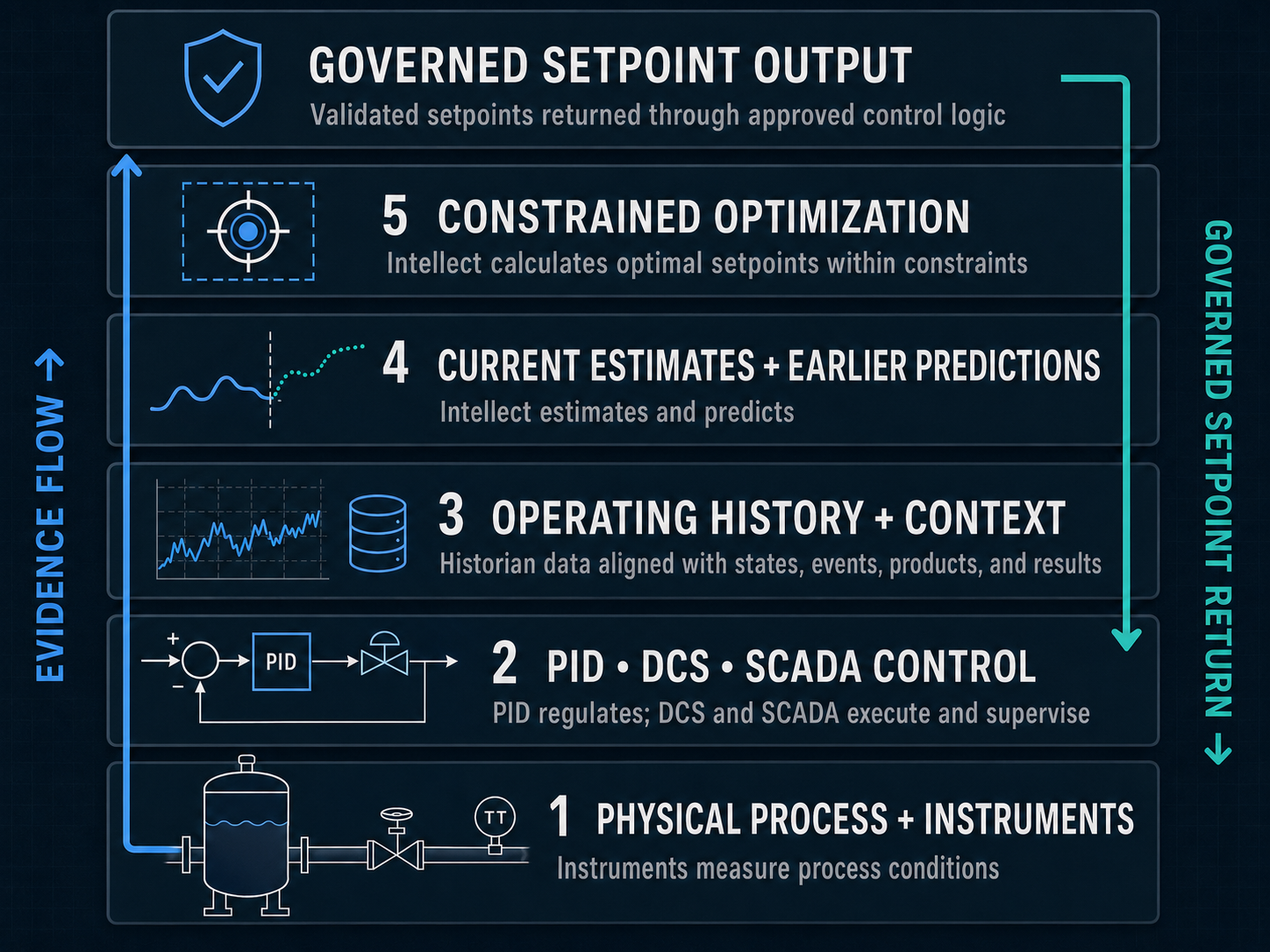
Select the diagram to open the full-size image.
Prediction lets the control stack act earlier
Feedback control reacts to a measured difference. That response is exactly right when the measurement is timely and the controlled variable is available.
Many valuable industrial results are not available at the required time.
A laboratory result can arrive after the batch is complete. An analyzer can report composition after the relevant process behavior. A final inspection can reveal nonconformance after the material, energy, and production capacity are used, over and done. An operating condition can be important even when the instrument is unavailable or unreliable.
Intellect uses current operating evidence to estimate values that are not measured continuously and predict results before their corresponding measurements become available. Optimization then uses those estimates and predictions to calculate the setpoints required for current conditions and raw materials in use.
The result is not AI instead of control. It is better information and better operating results supplied to the control layer.
Field implementation requires the whole stack
A model by itself does not operate a plant. In fact, it’s only about 10% of a typical solution.
An industrial application must connect to the required measurements and records. It must identify valid operating states, qualify incoming data, preserve engineering context, execute reliably, monitor model performance, apply limits and governance, communicate with the operating systems, and recover cleanly when connections or services restart.
In one condensate-stabilization implementation, IntelliDynamics connected to a process historian and a Yokogawa DCS through OPC. Intellect predicted Reid Vapor Pressure before the delayed analyzer result became available. Intellect’s optimizer inverted the predictive model to calculate reboiler-temperature setpoints on a determined interval. DCS logic inspected and accepted the setpoint before the existing cascade control system acted on it.
The PID layer remained in service. Prediction and optimization gave it a better setpoint for current conditions.
The same architecture applies to many industrial objectives. An application can calculate steam, choke, lift-gas, temperature, pressure, flow, speed, blend, or material targets. The exact objective, constraints, operating authority, and acceptance logic remain specific to your process.
Operators need useful results in operating systems
A process engineer does not improve control by adding an isolated dashboard that the operator must remember to watch.
The estimate, prediction, diagnostic result, recommendation, or setpoint belongs in the established operating workflow. IntelliDynamics returns results through the DCS, SCADA system, historian, database, alarm system, or engineering tool already used by the operation.
Governance remains explicit. An application can provide advice for operator acceptance, supply a setpoint through customer-approved logic, or participate in a closed-loop implementation where the process, safeguards, permissions, and acceptance criteria are automated. Your choice.
This is industrial software, not a demonstration notebook.
Engineers need the full stack
Engineering education has expanded before. Engineers learned digital control, historians, databases, optimization, simulation, and automation as those capabilities became part of industrial practice.
Artificial intelligence adds another body of knowledge. Engineers need to understand models, validation, data qualification, operating coverage, model-performance management, deployment, cybersecurity, integration, and human responsibility. They also need enough software and systems knowledge to understand how an analytical result reaches the process and keeps working.
This does not reduce the importance of chemical, mechanical, electrical, control, manufacturing, petroleum, or process engineering. It makes those foundations more valuable.
The engineer who understands the physical process and the expanded technology stack can determine what belongs in each layer, what evidence is trustworthy, what constraints matter, and where automation creates real operating value. We help you through that process.
Long live PID
PID is not disappearing. Neither are field instruments, control systems, historians, process models, or engineering judgment.
Industrial artificial intelligence earns its place when it strengthens that foundation. It makes an important result available sooner. It identifies what matters. It calculates a better operating objective. It supplies a governed target to the system responsible for acting on it.
The future is not PID versus AI.
PID is still there. We set the setpoints optimally. It is a stack.