Industrial AI
Put Your Factory Data to Work
Use the historian, DCS, laboratory, SQL, spreadsheet, product, and engineering data you already have to deliver useful operating results.
- Industrial AI
- Manufacturing
- Process Data
Your laboratory releases the quality result after your batch is done. Your analyzer reports a stream composition after the process has already changed. Final inspection tells you what production made after the material, energy, and capacity are used.
Those delays leave engineers and operators acting without the current information they actually need.
The historian, DCS and SCADA system, materials records, laboratory database, product tests, and engineering files often contain the evidence needed to make that information available while there is still time to act. IntelliDynamics® aligns that evidence around the physical operation. Intellect then estimates what cannot be measured continuously, predicts important results earlier, and calculates optimal setpoints given current conditions.
That is where we begin: with the measurement, prediction, or setpoint that gives you the information you need while the outcome can still be changed.
Start with the operating result
Industrial analytics projects often become infrastructure programs before anyone has defined the result that operations needs.
You may hear that you must consolidate all your data first, standardize every source, move years of history into a new platform, and establish a complete enterprise architecture before solving one operating problem. Those activities may serve broader goals, but they are not prerequisites for every focused prediction, estimation, diagnostic, or optimization application.
A useful application begins with a narrower question:
What information does the operation need earlier, more often, or continuously?
That question determines which evidence matters. It also prevents the project from collecting data without a defined operating purpose.
The data does not need to live in one system
Data in a historian? No problem.
Data in a DCS or SCADA system? No problem.
Data in Excel, engineering files, or product records? No problem.
Laboratory results in a SQL database? No problem.
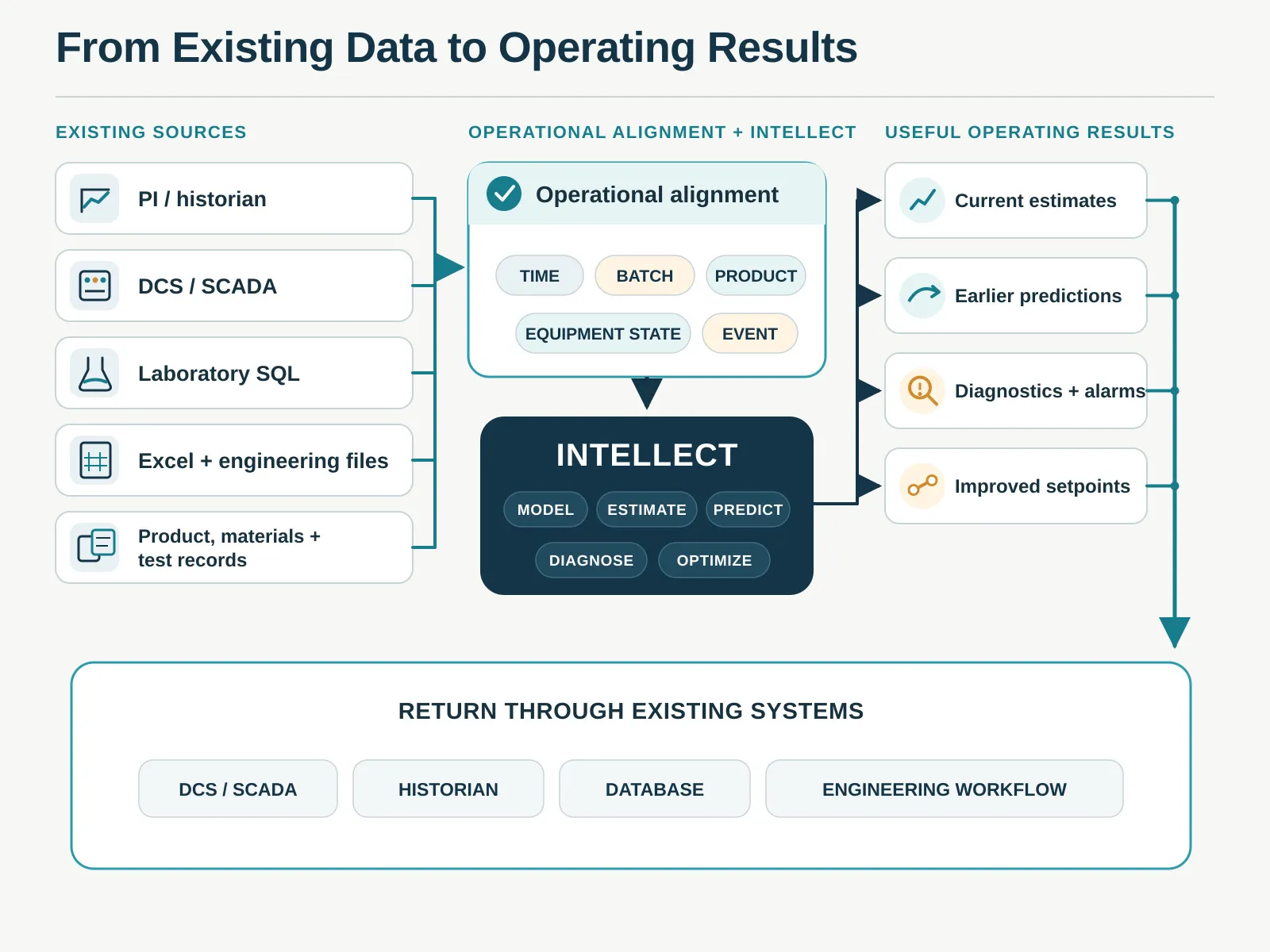
IntelliDynamics connects historians, DCS and SCADA systems, OPC sources, databases, laboratory systems, spreadsheets, files, product and materials records, test systems, and manual events. Intellect obtains the data at its source and uses the relevant evidence to model, estimate, predict, diagnose, and calculate improved operating setpoints.
The systems retain their established roles. The historian records and serves process history. The DCS and SCADA system operate and supervise the process. Laboratory systems preserve test results. Engineering and product systems retain their own records.
Intellect connects the evidence needed for the operating result without pretending those systems should be replaced by one new source.
Operational alignment
Build one analytical view around the result
A useful analytical data set is organized around the physical operation. IntelliDynamics aligns timestamps, sampling intervals, engineering units, batches, products, runs, equipment states, delayed laboratory results, missing values, and manual events and structures the data so each value carries the context needed for the model and the operating decision.
Alignment is more than putting columns together
Industrial sources operate on different clocks.
A pressure may update every second. A historian may archive a compressed series. A laboratory result may arrive 30 minutes or several hours after the sample was taken. Product measurements may belong to a batch, roll, product, or shipment rather than one timestamp. Materials may be identified by lot. Equipment may be starting, stopping, cleaning, changing grade, or outside normal ranges.
Putting those values in adjacent columns does not establish the relationship between them.
The engineering work includes:
- connecting each tag to the correct asset, batch, product, run, or event
- reconciling timestamps and sampling intervals
- preserving the distinction between sample time and result-availability time
- converting and checking engineering units
- identifying valid operating states
- qualifying missing, stale, delayed, or out-of-range values
- retaining the context needed to interpret each result
This is how distributed industrial data becomes one useful analytical view.
Existing data produced a current operating result
A condensate-stabilization application shows how this works in production.
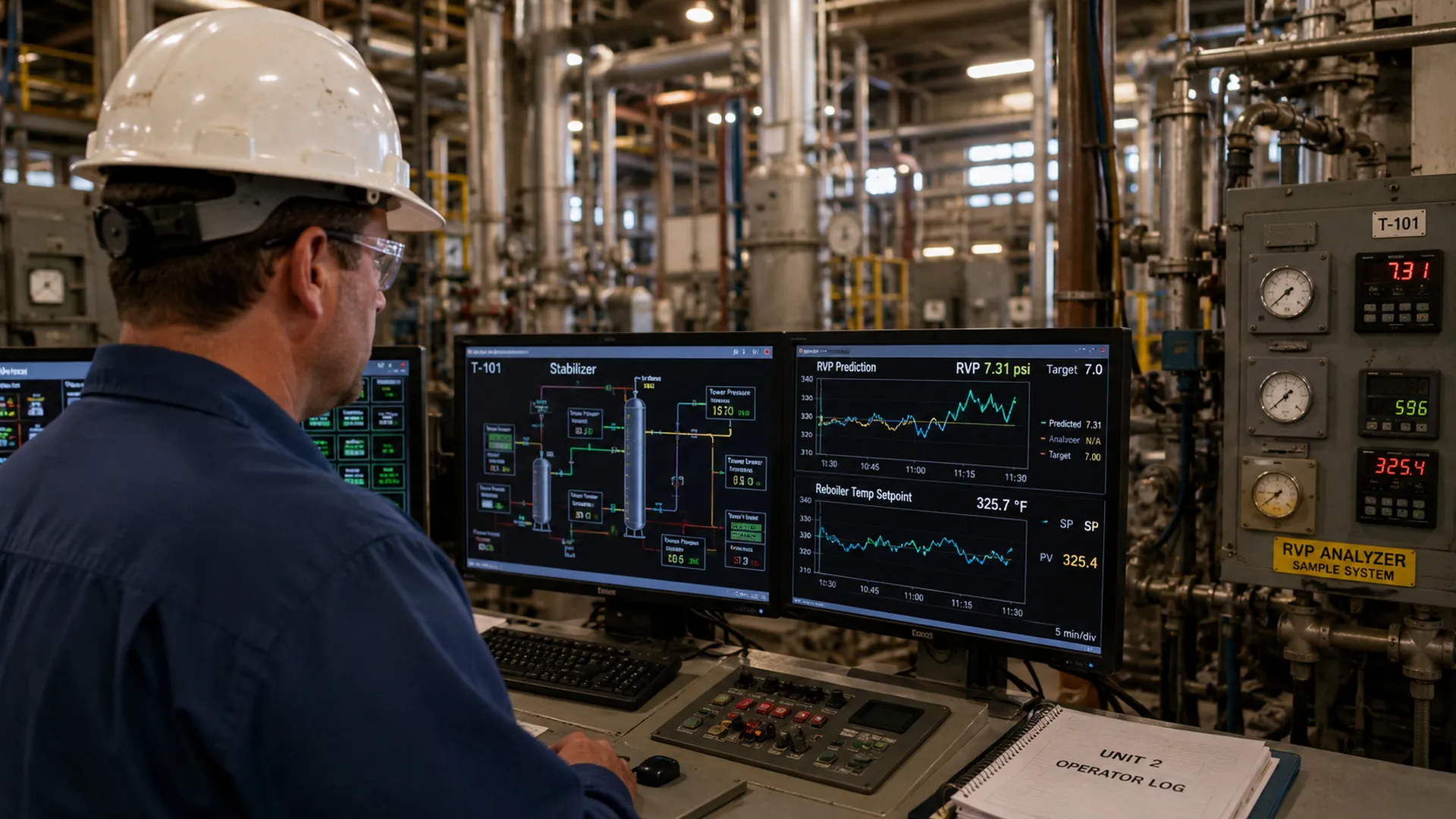
The operation needed to control Reid Vapor Pressure (RVP), but the product analyzer reported the result 15 to 30 minutes after the relevant process behavior. Feed rate, composition, liquid slugs, reboiler conditions, temperatures, pressures, levels, and flows could change before the analyzer showed the effect.
IntelliDynamics used more than 12 process variables sampled from one-minute OSIsoft PI historian data. Intellect predicted RVP 15 minutes ahead and refreshed the prediction every five seconds. The system inverted the predictive RVP model to determine the reboiler temperature setpoint needed to move RVP toward target, then passed the result through governed logic connected to the existing Yokogawa DCS via OPC.
On the first tower, product within specification increased from 18% to 58%. Over-stabilized product fell from 68% to 38%, and product variance fell from 3.21 psi to 0.28 psi. Online prediction accuracy was 99% over five months, with 98% system availability. After validation, the application was extended to three additional towers.
The value did not come from moving every source into a new enterprise data platform. It came from selecting the relevant evidence, aligning it around the physical process, producing a useful prediction and setpoint, and returning the result through the operating system already in use.
Results vary. Feed behavior, equipment, instrumentation, control condition, product limits, implementation, and economics affect performance.
Return the result through existing systems
Industrial teams and operators do not need another browser dashboard to run the process.
IntelliDynamics delivers current estimates, earlier predictions, diagnostic evidence, alarms, recommendations, and calculated setpoints through the DCS, SCADA system, historian, database, or engineering workflow already used by the operation.
That preserves the tools, displays, permissions, procedures, and operating knowledge already present in the plant. It also keeps the analytical result close to the person and system responsible for acting on it.
Use the data you already collect
The practical starting point is not a debate about whether the plant has perfect data architecture.
Define the operating result. Identify the key drivers already being collected. Connect the necessary sources. Align the values around the product, process, asset, and event. Qualify the data. Build and validate the operating application. Return the result through the systems people already use.
For more than 30 years, IntelliDynamics has helped industrial teams use existing data to model, predict, understand, and improve products and processes.
The question is simple: what result does your operation need earlier, more often, or continuously?