Industrial AI
The Industrial AI Stack
Industrial AI creates operating value when materials, process behavior, product characteristics, control, data, prediction, optimization, and business objectives connect.
- Industrial AI
- Process Control
- Optimization
Industrial AI has a stack.
That fact gets missed in many AI discussions. The conversation moves quickly to data platforms, algorithms, agents, copilots, dashboards, and model performance. Those things can matter. They become valuable only when they connect to the operating reality of the plant.
Industrial value starts with the physical process.
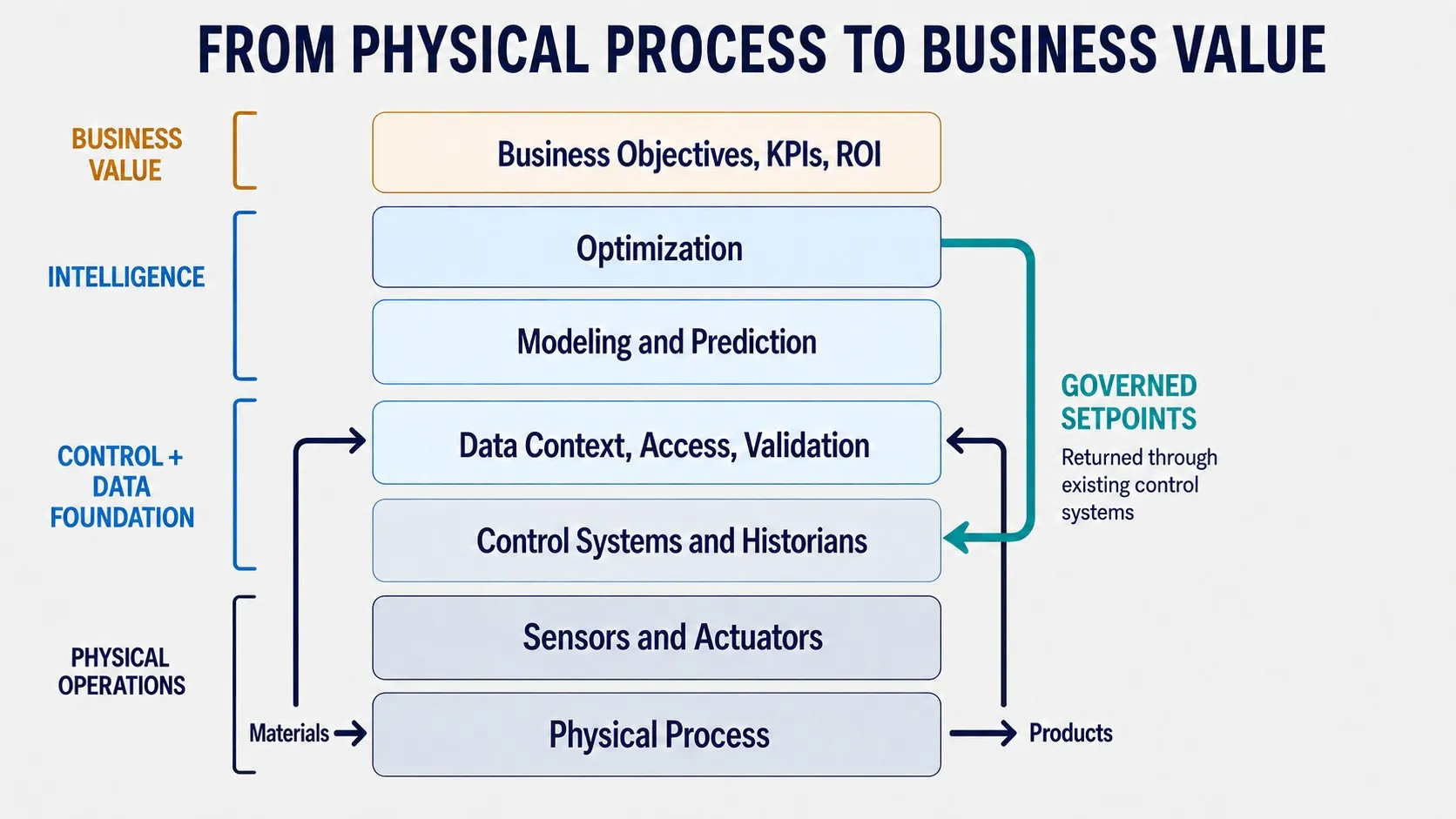
Materials enter the physical process with their associated characteristics. Products leave it with properties that determine quality, value, acceptance, and downstream performance. Sensors and actuators are the eyes and hands of the control layer. Control systems keep the plant moving and under control. Historians preserve the operating record. Material information, product characteristics, process measurements, equipment states, and operating history are stored in the data layer where context, access, and validation make the record useful.
Industrial AI belongs in that full operating stack.
At IntelliDynamics, we start with the physical process and build upward from there. We connect plant behavior, operating history, engineering context, data access, validation, modeling, prediction, adaptation, performance monitoring, confidence calculations, reporting, optimization, governed setpoints, and business objectives.
That is how Industrial AI moves from the physical process to the business value.
The Industrial AI stack connects materials, physical process behavior, product characteristics, control systems, historians, data context, modeling, prediction, optimization, governed setpoints, and business value.
The physical process is where value is created
A plant creates value by converting materials into products with the required characteristics, quality, and reliability, with judicious use of energy, assets, labor, and time.
The process is physical. Material properties change. Equipment fouls. Ambient conditions move. Instruments drift. Product characteristics can become available after the process conditions that created them. Tests provide snapshots along the way. Operators respond to information that appears in the control system, materials and product quality from the Lab Information Systems (LIMS), and issue process adjustments, issue maintenance requests, using the accumulated experience of the plant team.
Successful Industrial AI systems must understand those realities and make use of the available materials data, process conditions and limits, production recipes, product performance targets and actual results, inspections, test data, equipment states, operating modes, and business objectives that define the actual objectives for delivering notable business results in real time.
The plant is not an afterthought in the architecture. The plant is the architecture.
The control and data foundation carries the operating record
The control system and the historian are central parts of the value path.
A distributed control system, SCADA system, programmable controller, historian, and engineering toolset already contain much of the process operating record. They also provide the practical route for returning useful results to operations.
The work is to make that operating record useful for the problem at hand.
A tag has a meaning. A measurement is taken on time or lot basis. Material information needs a relationship to the process state. A product characteristic needs a relationship to the materials and process conditions that created it. A laboratory result needs a sample time based on when the sample was taken and a relationship to the process state. A historian value can represent a sensor, a calculated value, a manual entry, a control output, a selected operating target, or a quality result that became available later.
Context determines what the data can prove.
At IntelliDynamics, data context, access, and validation are part of the engineering work. They are required for reliable modeling, prediction, optimization, and operating use. Good Industrial AI depends on the right process evidence, not just available data.
Modeling and prediction are systems, not a model
The modeling and prediction layer can be large.
In real industrial systems, one unit operation can require many models. A large proposed system can involve hundreds of unit operations and thousands of models. The useful layer includes more than estimation and prediction. It can include auto-calibration, adaptation, performance monitoring, confidence calculations, reporting, model management, validation against reference values, and operating-condition awareness.
That matters because industrial conditions change.
A model that worked under one set of conditions must be monitored as the process moves. Estimates need performance checks. Confidence must be calculated and communicated. Calibration and adaptation must be governed. Reports must show whether the system is performing well enough to support operational use.
This is how engineers and operators gain confidence.
A current estimate can make a value visible when continuous measurement is unavailable. A prediction can show an important future result earlier than the physical measurement. A confidence calculation can show whether the result deserves attention, review, or action. Performance monitoring can show whether the system remains fit for use.
These functions make the operating record more useful. They help people see sooner, decide with better evidence, and act with greater confidence.
Optimization connects operating action to business objectives
Optimization delivers product performance and business objectives.
A plant can optimize for throughput, yield, quality, energy, reliability, emissions, cost, stability, asset utilization, or a constrained combination of objectives. The business objective defines what “better” means under current conditions.
Optimization calculates better setpoints or even materials selection for the objective and constraints in front of the plant.
Those targets can take different forms. They can be governed closed-loop setpoints, recommended setpoints, advisory values, calculated inputs, or operator guidance. The destination can be the DCS, SCADA system, historian, engineering tool, trend, report, or existing operating interface.
Governance matters. Industrial plants require limits, validation, accountability, operating policy, and respect for the control architecture. The result must fit the way the plant is operated.
Business value appears when the whole stack is connected
The stack shown in the graphic is the practical path:
- materials entering the physical process;
- physical process;
- products and product characteristics;
- sensors and actuators;
- control systems and historians;
- data context, access, and validation;
- modeling, prediction, adaptation, monitoring, reporting, and confidence calculations;
- optimization;
- business objectives, KPIs, and ROI;
- governed setpoints returned through existing systems.
Each layer has a job. Each layer depends on the others. The value path runs from material behavior, process behavior, and product characteristics to business result and back to operations.
This is established engineering practice at IntelliDynamics. We provide modeling, prediction, and optimization of product and process performance, connected to the systems industrial teams already use.
Our customers use Industrial AI to improve operating value because the work is tied to the plant. The result is better visibility, better evidence, better targets, and more confident action through the operating systems already in place.
Industrial AI has a stack. The companies that understand the full stack are the ones that turn process behavior into business value.